
Nikkei 225 index sector weightings
The share of the Nikkei 225 held in each equity sector, at each year end from 2018 to 2025.
Information Technology is the largest sector at 28.68%, followed by Consumer Discretionary at 18.75% and Industrials at 18.22%. One caution before reading any of it: the Nikkei 225 is price-weighted, not capitalisation-weighted, and that changes what these numbers mean.
| Sector | Dec 2025latest | Dec 2023 | Dec 2022 | Dec 2021 | Dec 2020 | Dec 2019 | Dec 2018 |
|---|---|---|---|---|---|---|---|
| Information Technology | 28.68% | 24.23% | 18.83% | 23.95% | 17.18% | 17.56% | 13.70% |
| Consumer Discretionary | 18.75% | 20.97% | 20.38% | 18.79% | 21.81% | 20.56% | 21.10% |
| Industrials | 18.22% | 18.39% | 19.44% | 19.32% | 18.37% | 19.36% | 19.89% |
| Communications | 12.45% | 9.45% | 11.06% | 9.50% | 11.42% | 9.08% | 9.37% |
| Health Care | 7.97% | 10.27% | 13.12% | 12.20% | 14.44% | 13.05% | 11.36% |
| Materials | 4.49% | 6.59% | 5.70% | 6.13% | 6.49% | 6.28% | 7.16% |
| Consumer Staples | 4.03% | 5.42% | 6.38% | 6.22% | 6.50% | 9.10% | 11.74% |
| Financials | 3.22% | 2.66% | 3.11% | 2.03% | 1.98% | 2.40% | 2.62% |
| Real Estate | 1.69% | 1.57% | 1.53% | 1.47% | 1.47% | 2.08% | 2.35% |
| Energy | 0.31% | 0.28% | 0.29% | 0.25% | 0.20% | 0.33% | 0.46% |
| Utilities | 0.19% | 0.17% | 0.16% | 0.13% | 0.15% | 0.19% | 0.25% |
Weights are the share of total index value in each sector at the date shown, and sum to 100%. A sector with no constituents in the index that year shows 0.00%; a dash means the sector did not exist under the classification in use at the time.

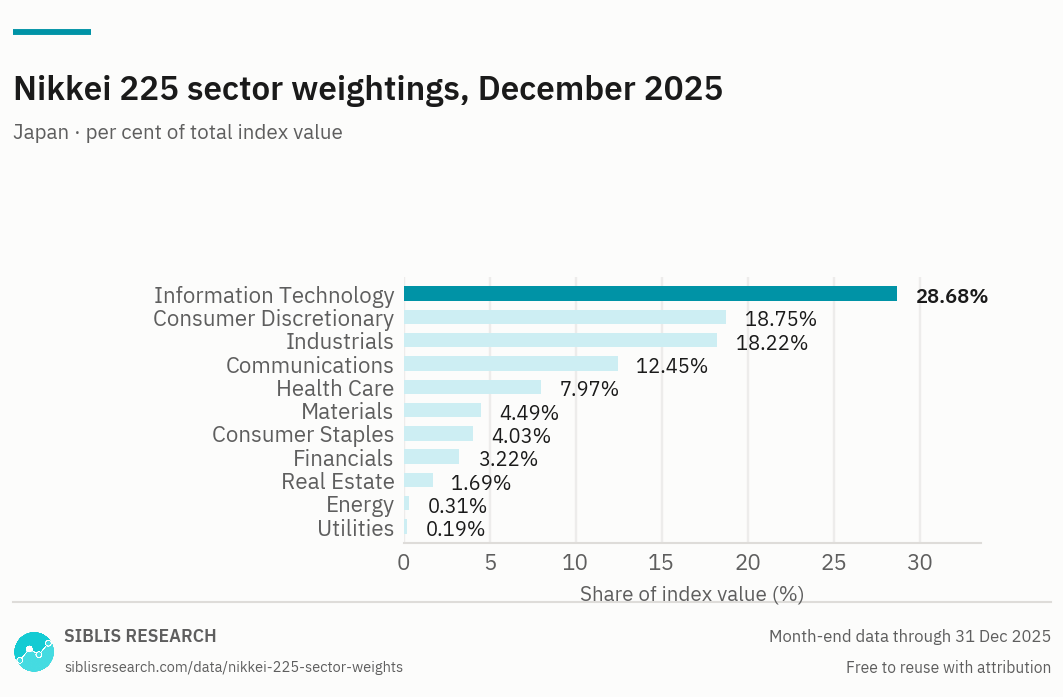
11 sectors, ranked. Financials sits near the bottom at under 3% — in a capitalisation-weighted Japanese index it would be several times that.
The weighting method matters more here than anywhere else
The Nikkei 225 is price-weighted: a constituent's influence depends on its share price rather than on the size of the company. A firm whose shares trade at ¥40,000 carries eight times the weight of one trading at ¥5,000, regardless of which is the larger business.
The consequence for this table is direct. These weights do not represent the sector composition of the Japanese stock market. Financials at under 3% is the clearest example: Japanese banks are large companies with low share prices, so they are heavily under-represented here relative to their market value. Anyone wanting the sector shape of the Japanese market rather than of this particular index needs a capitalisation-weighted benchmark.
What the history shows
Information Technology rose substantially over the period, ending well above where it began, and is now the largest sector in the index. Consumer Staples roughly halved. Health Care has drifted down since 2020. Consumer Discretionary — Japan's carmakers and consumer electronics — has been the second largest sector throughout without moving much.
Reading the Nikkei's valuation
The same caution applies to the index multiple. A price-weighted index's P/E is a price-weighted average of its constituents' economics, which is not the same thing as the market's. The Nikkei valuation page publishes the ratios with the same caveat attached.
How these weights are compiled
- Source — Constituent-level sector classification and index weights, aggregated to sector level.
- Basis — Weights are the share of total index value held by each sector at the date shown, and sum to 100%.
- Frequency — Compiled once a year, at year end. The date on the table is the date the weights refer to.
- Sectors — The standard eleven-sector scheme. Communications replaced Telecommunications when the classification changed, so the two are shown as separate rows where the history spans that change.