
Russell 2000 index sector weightings
The share of the Russell 2000 held in each equity sector, at each year end from 2019 to 2025.
Health Care is the largest sector at 18.74%, followed by Financials at 17.72% and Industrials at 17.33%. The small cap index is spread far more evenly across sectors than any U.S. large cap benchmark.
| Sector | Dec 2025latest | Dec 2024 | Dec 2023 | Dec 2022 | Dec 2021 | Dec 2020 | Dec 2019 |
|---|---|---|---|---|---|---|---|
| Health Care | 18.74% | 16.31% | 15.43% | 16.87% | 18.05% | 21.11% | 18.22% |
| Financials | 17.72% | 18.65% | 16.86% | 17.23% | 16.02% | 15.32% | 17.59% |
| Industrials | 17.33% | 17.85% | 17.07% | 15.57% | 15.20% | 15.35% | 15.84% |
| Information Technology | 14.78% | 13.84% | 13.60% | 12.72% | 14.53% | 14.13% | 13.56% |
| Consumer Discretionary | 8.99% | 9.67% | 11.04% | 10.41% | 11.34% | 13.07% | 10.89% |
| Real Estate | 5.67% | 6.07% | 6.14% | 6.42% | 7.43% | 6.20% | 7.80% |
| Energy | 4.80% | 5.12% | 6.89% | 6.79% | 4.36% | 2.09% | 3.19% |
| Materials | 4.41% | 4.27% | 4.49% | 4.30% | 3.82% | 4.20% | 3.91% |
| Utilities | 3.01% | 2.70% | 2.74% | 3.51% | 2.68% | 2.98% | 3.68% |
| Communications | 2.71% | 2.70% | 2.32% | 2.58% | 3.12% | 2.33% | 2.31% |
| Consumer Staples | 1.84% | 2.81% | 3.41% | 3.60% | 3.47% | 3.22% | 3.02% |
Weights are the share of total index value in each sector at the date shown, and sum to 100%. A sector with no constituents in the index that year shows 0.00%; a dash means the sector did not exist under the classification in use at the time.

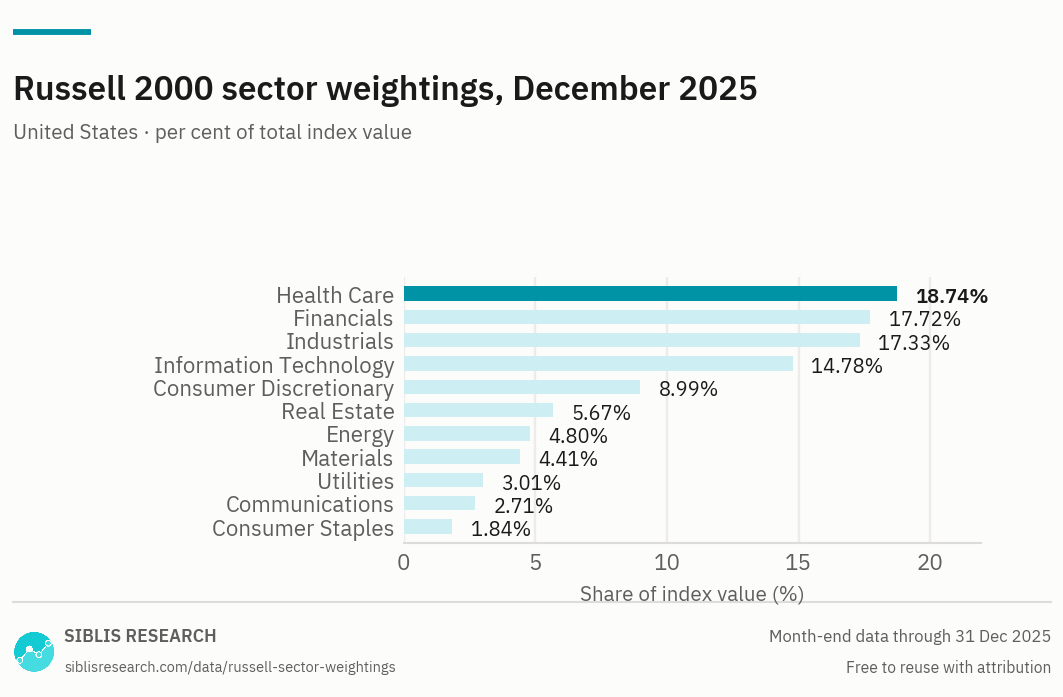
11 sectors. No sector reaches 20%, and the top four are within a few points of each other — a very different shape from U.S. large caps, where one sector dominates.
Small caps are not large caps in miniature
The most useful thing in this table is how flat it is. The largest sector is under a fifth of the index and the top four are clustered together. In the U.S. large cap benchmark a single sector accounts for far more than that on its own.
Information Technology is a moderate weight here rather than the dominant one, and Health Care is large — small cap health care is mostly clinical-stage biotechnology, which is a different business from large cap pharmaceuticals and behaves differently. Real Estate and Utilities both carry meaningful weights that would be rounding errors in a large cap index.
The practical consequence: a portfolio that holds a U.S. large cap index and a small cap index is not holding two sizes of the same thing. It is holding two different sector mixes, and much of the return difference between them in any given year is that mix rather than the size factor.
What the history shows
Health Care has fallen substantially from its 2020 peak, when clinical-stage biotech valuations were at their highest. Financials and Industrials have both risen. Energy moved sharply with the oil price, more than doubling between 2020 and 2022 before easing.
Why this matters for the small cap multiple
The Russell 2000's headline P/E runs higher than the large cap one, and the reason is not this table — it is that an aggregate ratio nets the losses of unprofitable constituents against everyone else's profits, and a small cap index holds a great many of those. The Russell 2000 valuation page sets that out, along with what the premium looks like measured against its own history.
How these weights are compiled
- Source — Constituent-level sector classification and index weights, aggregated to sector level.
- Basis — Weights are the share of total index value held by each sector at the date shown, and sum to 100%.
- Frequency — Compiled once a year, at year end. The date on the table is the date the weights refer to.
- Sectors — The standard eleven-sector scheme. Communications replaced Telecommunications when the classification changed, so the two are shown as separate rows where the history spans that change.