
Global stock market valuations
Key valuation ratios for the Global equity index, an index of the 3,000 largest public companies based in both developed and emerging markets, United States included.
The trailing P/E series for the world index begins in 1970, which covers the 1973–74 bear market, the inflation of the late seventies, the 1987 crash, the Japanese bubble, the dot-com peak and bust, and the 2008 financial crisis.
| Index | Trailing P/E | Chg | Forward P/E | CAPE |
|---|---|---|---|---|
| Globalthis page | 22.07 | -0.47 | 16.91 | 29.69 |
| Developed markets | 23.42 | -0.63 | 18.58 | 31.93 |
| Emerging markets | 17.23 | +1.53 | 10.16 | 19.34 |
| Global ex-U.S. | 17.44 | +0.71 | n/a | 21.49 |
| United States | 26.08 | +1.33 | 20.13 | 36.41 |
| Europe | 19.32 | +0.60 | 15.39 | 23.87 |
Every ratio is calculated on the aggregate: total market capitalisation of the index divided by the aggregate earnings of its constituents, not an average of the constituents' individual ratios. Global includes the United States and covers developed and emerging markets.

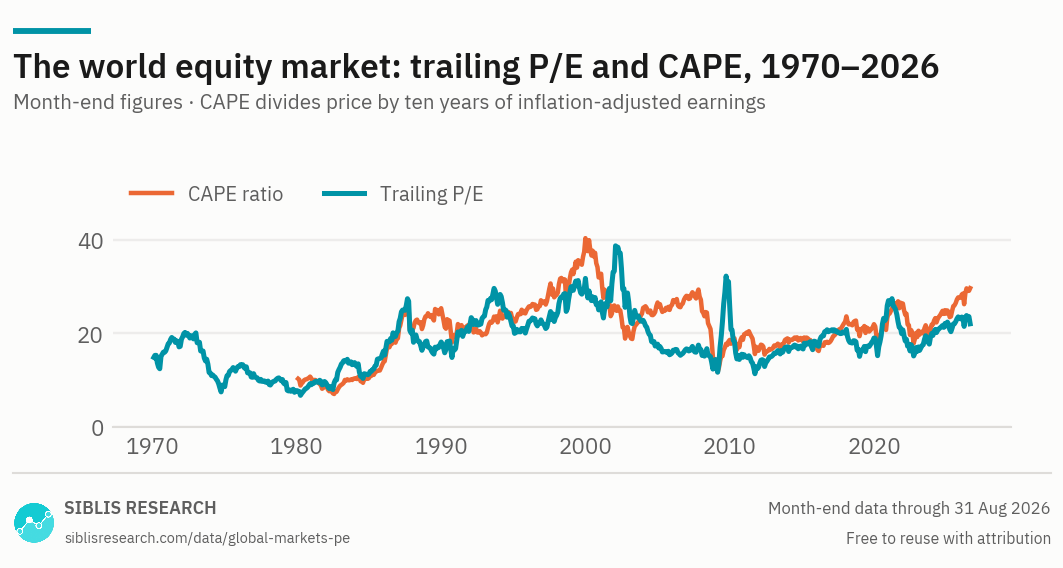
The two lines answer different questions. Trailing P/E spikes when earnings collapse — 2009 is the clearest case, and the market was cheap at the moment the ratio peaked. CAPE holds nine other years in its denominator and does not move that way.

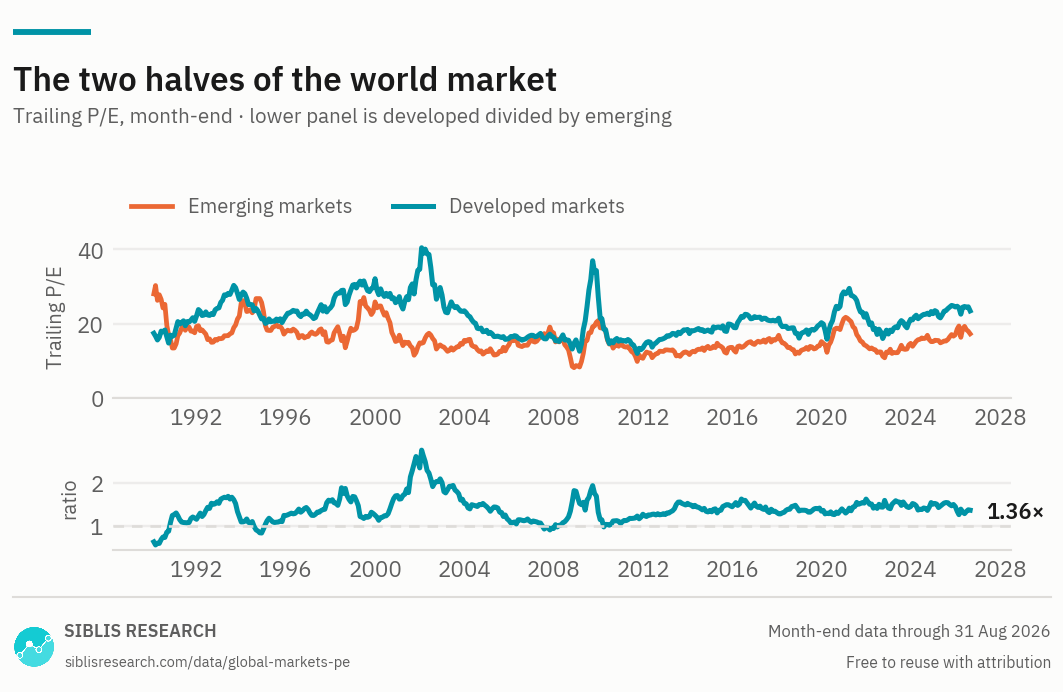
Developed markets have traded above emerging markets in all but 24 of the 440 months since 1990, and the ratio has ranged from 0.55 to 2.76. Today's 1.36 sits close to its own historical median of 1.37 — unlike the U.S.-against-the-world gap on the global ex-U.S. page, which does not.
| Month | Global | Developed markets | Emerging markets | Global ex-U.S. | United States | Europe |
|---|---|---|---|---|---|---|
| Aug 2026 | 22.07 | 23.42 | 17.23 | 17.44 | 26.08 | 19.32 |
| 2025 Dec | 23.12 | 24.49 | 16.98 | 17.65 | 25.38 | 19.38 |
| 2024 Dec | 21.61 | 22.67 | 15.13 | 15.01 | 24.61 | 17.44 |
| 2023 Dec | 20.00 | 21.18 | 14.67 | 15.89 | 21.79 | 15.00 |
| 2022 Dec | 16.19 | 17.18 | 12.18 | 13.45 | 18.55 | 13.05 |
| 2021 Dec | 20.76 | 22.67 | 14.02 | 15.71 | 26.14 | 19.96 |
| 2020 Dec | 27.03 | 28.57 | 21.28 | 23.52 | 31.05 | 52.37 |
| 2019 Dec | 19.02 | 20.24 | 15.14 | 16.76 | 21.78 | 19.29 |
| 2018 Dec | 15.10 | 16.07 | 11.98 | 13.99 | 16.77 | 13.49 |
| 2017 Dec | 20.10 | 20.78 | 15.93 | 18.33 | 21.84 | 20.73 |
| 2016 Dec | 20.61 | 21.88 | 14.35 | 20.10 | 20.59 | 25.93 |
The complete series — daily for the valuation ratios, back to 1970 — is part of the Global Equity Valuations Database.
Aug 2026
Where the world market stands, August 2026
The global index trades at 22.07 times trailing earnings and 16.91 times expected earnings for the coming year, with a CAPE ratio of 29.69.
The gap between trailing and forward is the earnings growth analysts have priced in. It is an expectation, not a forecast with a track record, and it is reliably more optimistic than what arrives.
The world index is mostly one country
Any statement about "global valuations" is heavily dominated by the United States, which is the largest weight in the index by a wide margin. The world figure and the American figure move together because one contains the other.
That is why the table above carries the global excluding the United States row. Read the two side by side rather than reading the world figure alone: the difference between them is what the world figure conceals. It is covered in full on the global ex-U.S. page.
Why the length of the series matters
A valuation reading only means something against a reference period, and the reference period decides the answer. Measured against the past ten years, almost any multiple looks normal, because ten years is rarely a full cycle. Measured against five decades, the same reading can sit in a different part of the distribution entirely.
The series here spans several complete cycles, including two in which the global multiple more than halved. That is the reference period worth using, and it is not available from a series that starts in the 1990s.
What the aggregate hides
An index-level ratio is a weighted average, and weighted averages conceal dispersion. The world index can look moderately valued while its largest constituents are extremely highly valued and its smallest are not. The aggregate cannot show that. Dispersion is visible in the sector tables and in the country rankings.
Choosing a region
Four cuts of the same world. Each page carries the full set of valuation measures for one index — what changes is which companies are in it.
| Index | The question it answers | What is in it |
|---|---|---|
| The world market this page | What is the whole equity market worth? | The world aggregate and its developed and emerging halves, with trailing P/E back to 1970. |
| The world excluding the U.S. | How much of world valuation is America? | The same market with U.S. companies removed, and the gap between the two over thirty years. |
| Emerging markets | How are emerging markets valued, and which ones? | The emerging aggregate and every emerging market behind it, side by side. |
| Europe | How is Europe valued against itself and against the U.S.? | The European aggregate and the individual European markets. |
Where this data is used
Some examples. Siblis valuation data appears in peer-reviewed journals, central bank publications and the financial press.
Fifty-six years of the world market
This page publishes twenty year-ends and the current reading. The Global Equity Valuations Database is the whole series, monthly from 1970.
How this is calculated
Aggregate market capitalisation of the index divided by the aggregate earnings of its constituent companies.
- Trailing P/E — Aggregate normalised net income over the previous twelve months. Major purely accounting gains and losses are removed.
- Forward P/E — Consensus estimates for the next twelve months, aggregated the same way.
- CAPE — Price divided by the average of ten years of inflation-adjusted aggregate earnings.
- Coverage — Global includes the United States and covers developed and emerging markets. Developed World and Emerging Markets are the two halves of it.
- Revisions — Figures are point-in-time. If a company later restates its results, the historic reading is left exactly as first published: the series reflects what was known at the time, not what is known now.
Cite this page
Siblis Research. (2026). Global Stock Market P/E Ratio [Data set]. Retrieved 31 August 2026, from siblisresearch.com/data/global-markets-pe/
@misc{siblis_global_markets_pe,
  title={Global Stock Market P/E Ratio}, author={{Siblis Research}},
  year={2026}, url={https://siblisresearch.com/data/global-markets-pe/},
  urldate={2026-08-31}}
Charts on this page may be reproduced free of charge with attribution to Siblis Research and a link to this page.