
Emerging markets valuations
Key valuation ratios for the Emerging Markets index (1,000 largest public companies from emerging markets) and for the individual EM countries with history back to 1990.
The index multiple and the markets behind it tell different stories. A capitalisation-weighted average of markets with different currencies, inflation rates and accounting conventions is a consistent series, but a poor summary. The market-level table is where you can see a better picture.
| Index | Trailing P/E | Chg | Forward P/E | CAPE |
|---|---|---|---|---|
| Emerging marketsthis page | 15.95 | -0.47 | 9.81 | 19.06 |
| Global | 21.60 | -1.53 | 16.31 | 29.05 |
| Developed markets | 22.96 | -1.51 | 17.95 | 31.21 |
| United States | 25.96 | +0.41 | 25.96 | 35.89 |
| Taiwan | 27.25 | +6.00 | 18.87 | 46.68 |
| India | 21.19 | -1.62 | 18.68 | 28.67 |
| China | 16.87 | -1.08 | 13.29 | 17.08 |
| Thailand | 15.59 | -0.59 | n/a | 16.67 |
| Saudi Arabia | 15.51 | -2.04 | n/a | 18.70 |
| Mexico | 14.52 | -1.53 | n/a | 17.50 |
| Malaysia | 14.38 | -0.75 | n/a | 15.96 |
| Poland | 13.69 | +1.52 | n/a | 20.27 |
| South Korea | 12.39 | -0.90 | 5.11 | 31.78 |
| South Africa | 12.07 | -2.41 | 8.47 | 18.14 |
| Indonesia | 11.42 | -5.35 | 8.72 | 14.99 |
| Brazil | 11.14 | +1.52 | 8.71 | 14.95 |
| Turkey | 8.92 | -5.12 | n/a | 6.75 |
| Philippines | 8.71 | -1.49 | n/a | 10.50 |
Every ratio is calculated on the aggregate: total market capitalisation divided by aggregate earnings, not an average of individual ratios. The index is weighted by market capitalisation, so the largest emerging markets dominate the index row. "Global" index in the table above includes both developed and emerging markets.

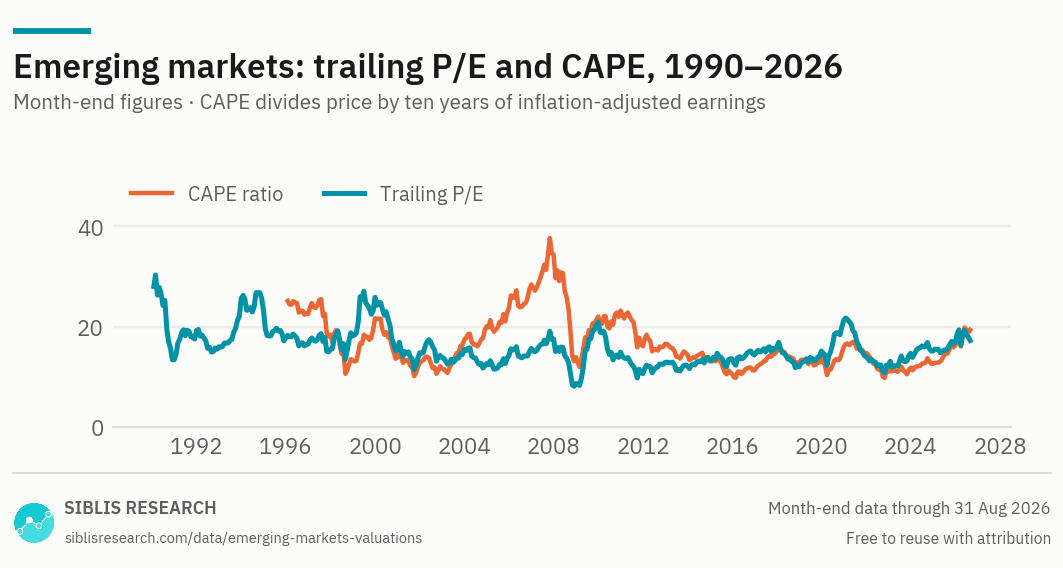
The 2008 CAPE peak and the 2009 trailing P/E spike are the same event seen two ways: prices fell and earnings fell further, so the trailing ratio rose while CAPE collapsed.

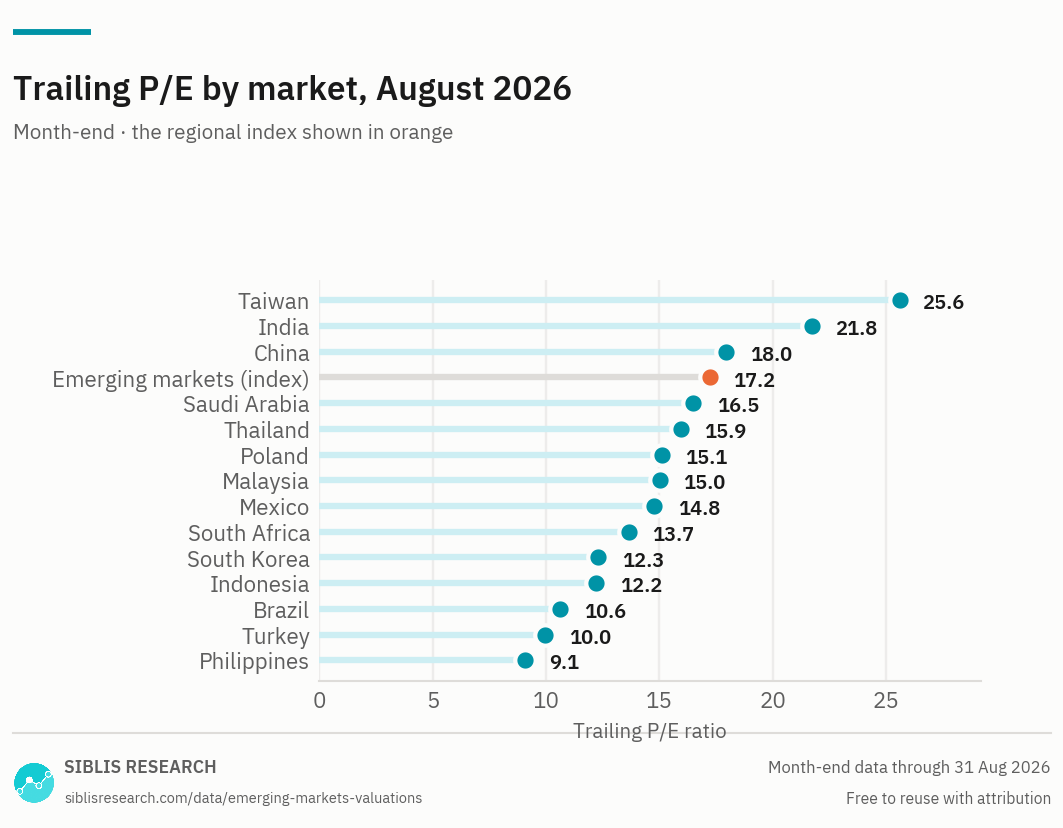
The individual markets, with the index shown in orange. The spread between the dearest and the cheapest is far wider than in any developed region.
| Month | Emerging markets | Global | Developed markets | United States |
|---|---|---|---|---|
| Sept 2026 | 15.95 | 21.60 | 22.96 | 25.96 |
| 2025 Dec | 16.98 | 23.12 | 24.49 | 25.38 |
| 2024 Dec | 15.13 | 21.61 | 22.67 | 24.61 |
| 2023 Dec | 14.67 | 20.00 | 21.18 | 21.79 |
| 2022 Dec | 12.18 | 16.19 | 17.18 | 18.55 |
| 2021 Dec | 14.02 | 20.76 | 22.67 | 26.14 |
| 2020 Dec | 21.28 | 27.03 | 28.57 | 31.05 |
| 2019 Dec | 15.14 | 19.02 | 20.24 | 21.78 |
| 2018 Dec | 11.98 | 15.10 | 16.07 | 16.77 |
| 2017 Dec | 15.93 | 20.10 | 20.78 | 21.84 |
| 2016 Dec | 14.35 | 20.61 | 21.88 | 20.59 |
The complete series — daily for the valuation ratios, back to 1990 — is part of the Global Equity Valuations Database.
Sept 2026
Inside the index
Where emerging markets stand, September 2026
The index trades at 15.95 times trailing earnings and 9.81 times expected earnings, with a CAPE ratio of 19.06. Among the individual markets, Taiwan is the most expensive at 27.25 and Philippines the cheapest at 8.71.
Historical valuation trends
Emerging markets have historically traded at lower equity valuation multiples compared to developed markets, reflecting higher economic and political risks, currency volatility, and less mature financial systems. For many decades, this has provided a powerful narrative for investing in emerging equity markets: as the economic and political landscape become more mature, both the earnings and valuation multiples of companies should rise. This would make emerging markets a more attractive alternative to place your capital compared to developed markets.
However, things have not really played out as expected by emerging markets advocates. As of 2025, the earnings multiples for emerging markets remain below those of developed markets and developed markets, especially the U.S. equity market, keep outperforming less developed counterparts.
The forward number deserves a second look
The gap between the trailing and forward multiples on this index is unusually wide, which implies a very large jump in earnings over the coming year. Before treating that as a forecast, look at which market it comes from: a single large index with a sharply cyclical earnings base can move the aggregate forward figure on its own, and the individual market rows above show where the expectation sits.
This is the general problem with aggregate forward multiples, and it is worse in emerging markets than in developed ones because the index is more concentrated and its constituents are more cyclical.
"Emerging" is a classification, not an economy
The markets in this index range from semiconductor exporters with developed-market income levels to commodity economies with a fraction of that. Their currencies, inflation rates, accounting conventions, tax regimes and index compositions have almost nothing in common.
The practical consequence: the index multiple is a useful series to track over time, because it is consistent with itself. It is a poor summary of "what emerging markets cost", because no single number can be. The market-level table is where that question gets answered.
Currency is doing more work than it looks
Every ratio here is calculated in a common currency. A market whose currency has weakened will show a falling multiple even if nothing about its companies changed, and over a decade currency moves in emerging markets are large enough to dominate the comparison. When a market's multiple looks cheap against its own history, the currency is the first thing to check.
Choosing a region
Four cuts of the same world. Each page carries the full set of valuation measures for one index — what changes is which companies are in it.
| Index | The question it answers | What is in it |
|---|---|---|
| The world market | What is the whole equity market worth? | The world aggregate and its developed and emerging halves, with trailing P/E back to 1970. |
| The world excluding the U.S. | How much of world valuation is America? | The same market with U.S. companies removed, and the gap between the two over thirty years. |
| Emerging markets this page | How are emerging markets valued, and which ones? | The emerging aggregate and every emerging market behind it, side by side. |
| Europe | How is Europe valued against itself and against the U.S.? | The European aggregate and the individual European markets. |
Where this data is used
Some examples. Siblis valuation data appears in peer-reviewed journals, central bank publications and the financial press.
Every emerging market, every trading day
This page publishes one reading a month for the index and the markets inside it. The Global Equity Valuations Database is the whole dataset.
How this is calculated
Aggregate market capitalisation of the index divided by the aggregate earnings of its constituent companies.
- Trailing P/E — Aggregate normalised net income over the previous twelve months.
- Forward P/E — Consensus estimates for the next twelve months, aggregated the same way. Not available for every market.
- CAPE — Price divided by the average of ten years of inflation-adjusted aggregate earnings.
- Coverage — The emerging markets index from 1990, and the individual markets from the date each enters the database.
- Revisions — Figures are point-in-time. If a company later restates its results, the historic reading is left exactly as first published: the series reflects what was known at the time, not what is known now.
Cite this page
Siblis Research. (2026). Emerging Markets P/E & Valuations [Data set]. Retrieved 30 September 2026, from siblisresearch.com/data/emerging-markets-valuations/
@misc{siblis_emerging_markets_valuations,
  title={Emerging Markets P/E & Valuations}, author={{Siblis Research}},
  year={2026}, url={https://siblisresearch.com/data/emerging-markets-valuations/},
  urldate={2026-09-30}}
Charts on this page may be reproduced free of charge with attribution to Siblis Research and a link to this page.