
Total market value of the U.S. stock market
The combined market capitalisation of every U.S.-domiciled public company listed on the New York Stock Exchange, Nasdaq and the OTCQX U.S. Market. At 30 September 2026 it stood at $78.7 trillion.
The table carries the full history back to 1998, in millions of U.S. dollars.
| Date | U.S. equity market valueUSD m |
|---|---|
| 30 Sep 2026 | 78,737,915.5 |
| 30 Jun 2026 | 75,282,047.1 |
| 31 Dec 2025 | 68,963,152.8 |
| 30 Jun 2025 | 62,825,048.8 |
| 31 Dec 2024 | 62,204,752.9 |
| 31 Dec 2023 | 50,781,697.5 |
| 31 Dec 2022 | 40,511,838.8 |
| 31 Dec 2021 | 52,263,018.2 |
| 31 Dec 2020 | 40,736,558.2 |
| 31 Dec 2019 | 33,905,976.7 |
| 31 Dec 2018 | 30,449,359.4 |
| 31 Dec 2017 | 31,774,585.4 |
| 31 Dec 2016 | 27,362,567.7 |
| 31 Dec 2015 | 25,076,923.7 |
| 31 Dec 2014 | 26,338,838.9 |
| 31 Dec 2013 | 24,041,484.6 |
| 31 Dec 2012 | 18,673,959.2 |
| 31 Dec 2011 | 15,645,563.9 |
| 31 Dec 2010 | 17,288,139.6 |
| 31 Dec 2009 | 15,081,511.9 |
| 31 Dec 2008 | 11,461,287.6 |
| 31 Dec 2007 | 19,670,052.9 |
| 31 Dec 2006 | 19,291,426.6 |
| 31 Dec 2005 | 16,919,160.8 |
| 31 Dec 2004 | 16,245,286.6 |
| 31 Dec 2003 | 14,177,207.6 |
| 31 Dec 2002 | 11,101,543.0 |
| 31 Dec 2001 | 13,858,390.2 |
| 31 Dec 2000 | 15,108,448.0 |
| 31 Dec 1999 | 17,601,921.0 |
| 31 Dec 1998 | 13,454,917.7 |
Figures are in millions of U.S. dollars, at the close of the date shown. May be reused with attribution.

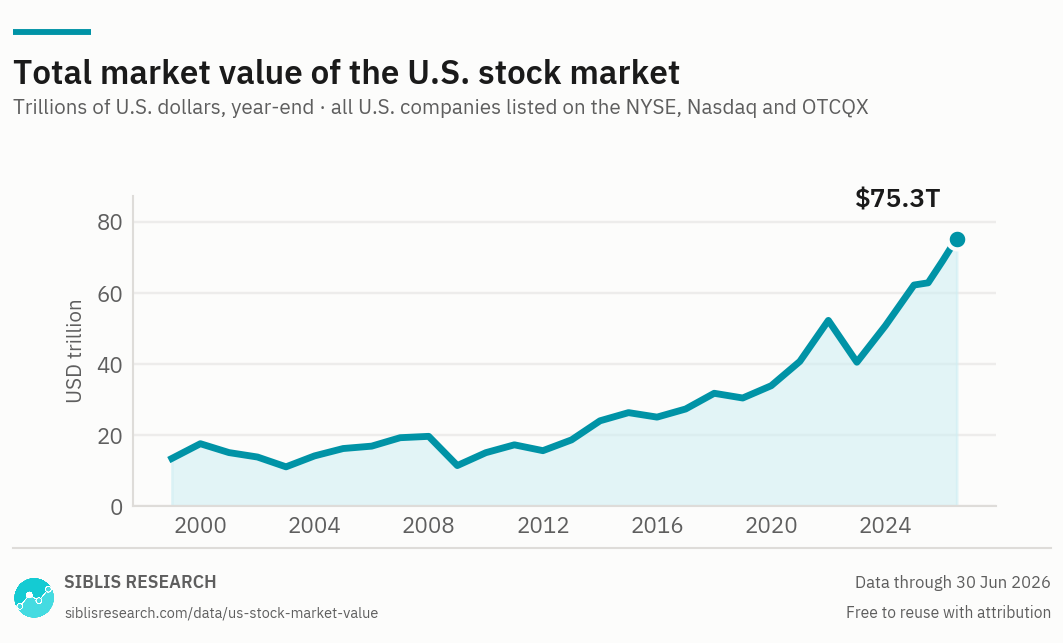
The total is a price series with a changing number of companies behind it: it rises when share prices rise, and also when companies list, and falls when they are taken private or bought. It is not a measure of how expensive the market is — see below.
Latest reading
The whole series
Where the total stands
The U.S. market was worth $78.7 trillion at 30 September 2026, against $13.5 trillion at the end of 1998 — a 485% increase over the period the table covers.
The path there was not a line. The lowest reading in the table is $11.1 trillion at the end of 2002, and the sharpest fall it records is −42 per cent in a single year, from $19.7 trillion at the end of 2007 to $11.5 trillion a year later.
What this number counts, and what it does not
It counts companies, not the economy. Every U.S.-domiciled company with a listing on one of the three venues is in the total at its own market price, which means the figure moves for three separate reasons: prices change, companies join the market through listings, and companies leave it through buyouts, delistings and takeovers.
That last pair matters more than it sounds. A decade in which the total rose 40 per cent while the number of listed companies shrank is a different decade from one in which the total rose 40 per cent on a widening market, and the headline figure cannot tell you which you are looking at. Read the level as what American public equity is worth, not as how American business has grown.
Foreign companies listed in New York are not counted, however large. The test is where the company is domiciled, not where its shares happen to trade.
A big number is not an expensive market
The total on its own says nothing about valuation. It is large because the American economy is large and because prices have risen; to turn it into a statement about whether the market is expensive you need a denominator.
The two usual ones are national income and earnings. Market capitalisation over national income — the ratio commonly called the Buffett indicator — is published for the major economies on market cap to GNI (GDP). Market capitalisation over profits is the P/E ratio, on P/E ratios by country and, for the U.S. indices individually, on U.S. large cap, NASDAQ 100, small caps, growth and value.
Why the reading is fixed once published
A figure here is point-in-time: it is the market's value as it was calculable on that date, and it is not restated afterwards. Share counts get revised, companies reclassify their domicile, and a delisting can be recorded weeks after the fact — none of that is applied backwards.
The alternative would be a series that moves underneath you, and a series that keeps changing cannot be compared with itself.
Valuation data for every major market, every trading day
This page publishes the level of the U.S. market. The Global Equity Valuations Database publishes what that level is worth against earnings, book value and cash flow, for 70+ markets and indices.
How this figure is compiled
The combined market capitalisation of U.S.-domiciled public companies, at the close of the date shown.
- Coverage — Companies domiciled in the United States and listed on the New York Stock Exchange, Nasdaq or the OTCQX U.S. Market. Foreign-domiciled companies are excluded whatever their listing venue.
- Market capitalisation — Shares outstanding multiplied by price, summed across companies. Not free-float adjusted: the figure is the whole company, not the tradable portion.
- Revisions — Figures are point-in-time. A reading is fixed once published and is not restated when share counts are later revised or when a company's status changes.
Where this data is used
Some examples. Siblis valuation data appears in peer-reviewed journals, central bank publications and the financial press.