
DAX index sector weightings
The share of the DAX held in each equity sector, at each year end from 2016 to 2025.
Industrials is the largest sector at 32.23%, followed by Financials at 21.32% and Information Technology at 15.89%. The DAX has no Energy constituents at all, which is unusual among the large European indices.
| Sector | Dec 2025latest | Dec 2021 | Dec 2020 | Dec 2019 | Dec 2018 | Dec 2017 | Dec 2016 |
|---|---|---|---|---|---|---|---|
| Industrials | 32.23% | 19.02% | 12.87% | 13.66% | 12.60% | 14.04% | 13.76% |
| Financials | 21.32% | 12.15% | 14.86% | 16.01% | 15.34% | 16.53% | 15.35% |
| Information Technology | 15.89% | 13.07% | 13.99% | 13.58% | 14.11% | 11.90% | 10.53% |
| Consumer Discretionary | 8.02% | 16.43% | 17.14% | 15.40% | 15.44% | 18.32% | 19.15% |
| Health Care | 6.12% | 10.37% | 8.74% | 11.36% | 11.11% | 13.58% | 15.11% |
| Communications | 5.99% | 4.01% | 4.46% | 4.47% | 5.44% | — | — |
| Materials | 4.46% | 16.65% | 17.36% | 17.16% | 17.58% | 13.74% | 14.19% |
| Utilities | 3.85% | 3.53% | 4.01% | 3.51% | 3.30% | 2.73% | 2.02% |
| Consumer Staples | 1.10% | 2.35% | 2.35% | 2.53% | 2.92% | 2.78% | 2.95% |
| Real Estate | 1.03% | 2.41% | 4.22% | 2.32% | 2.18% | 1.79% | 1.42% |
| Energy | 0.00% | 0.00% | 0.00% | 0.00% | 0.00% | 0.00% | 0.00% |
| Telecommunications (discontinued) | — | — | — | — | — | 4.59% | 5.52% |
Weights are the share of total index value in each sector at the date shown, and sum to 100%. A sector with no constituents in the index that year shows 0.00%; a dash means the sector did not exist under the classification in use at the time.

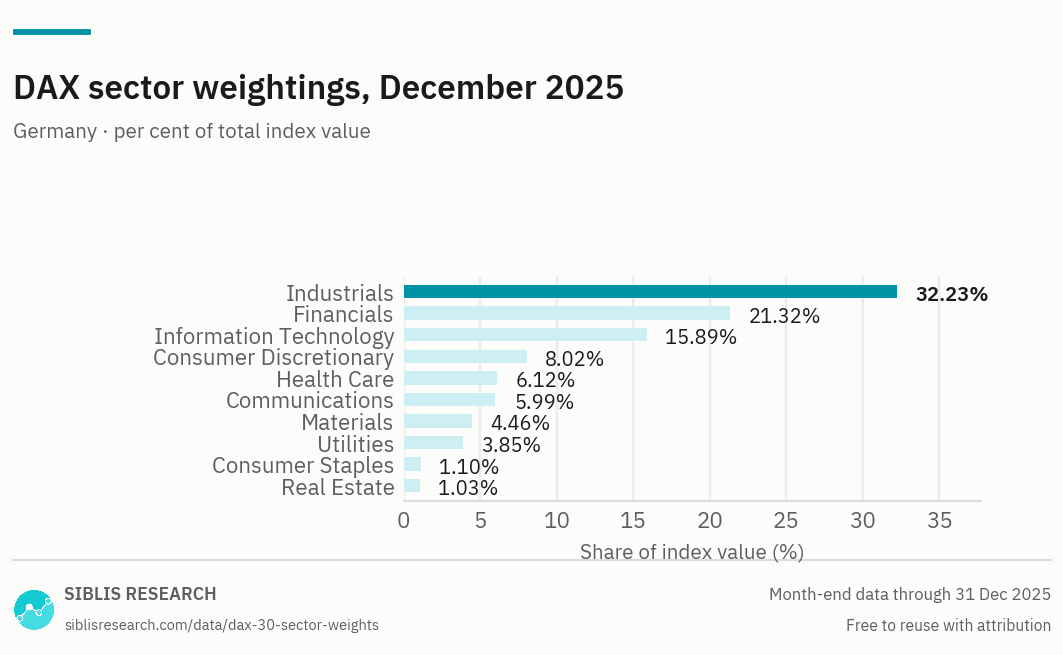
10 sectors with a weight above zero. Industrials, Materials and Consumer Discretionary together account for more than half the index — Germany's index is a manufacturing index in a way no other major benchmark is.
A manufacturing index
The DAX is the most followed benchmark for the German stock market, and its composition reflects what Germany makes rather than what it trades. Industrials, Materials and Consumer Discretionary — which in this index means carmakers — together dominate it.
The Energy weight is zero, and has been in every year shown. Germany's large utilities are classified under Utilities rather than Energy, and there is no integrated oil major in the index. That single absence is one of the reasons the DAX behaves differently from the FTSE 100 in years when the oil price moves sharply.
What the history shows
Over the period covered, Information Technology roughly doubled its share while Health Care and Financials both fell. Materials rose sharply between 2017 and 2018 and has held that level since. The Communications row begins in 2018: that sector replaced Telecommunications when the classification changed, so the two are shown separately rather than spliced into one series.
Sector mix and the German multiple
Comparing the German market's multiple with the American one without looking at this table misses most of the explanation. A benchmark built on carmakers, chemicals and industrial engineering carries the multiple those businesses carry — cyclical, capital-heavy, and rated accordingly. The DAX valuation page has the ratios themselves.
How these weights are compiled
- Source — Constituent-level sector classification and index weights, aggregated to sector level.
- Basis — Weights are the share of total index value held by each sector at the date shown, and sum to 100%.
- Frequency — Compiled once a year, at year end. The date on the table is the date the weights refer to.
- Sectors — The standard eleven-sector scheme. Communications replaced Telecommunications when the classification changed, so the two are shown as separate rows where the history spans that change.